

What Happens When AI Designs Your Interior Design Brand?
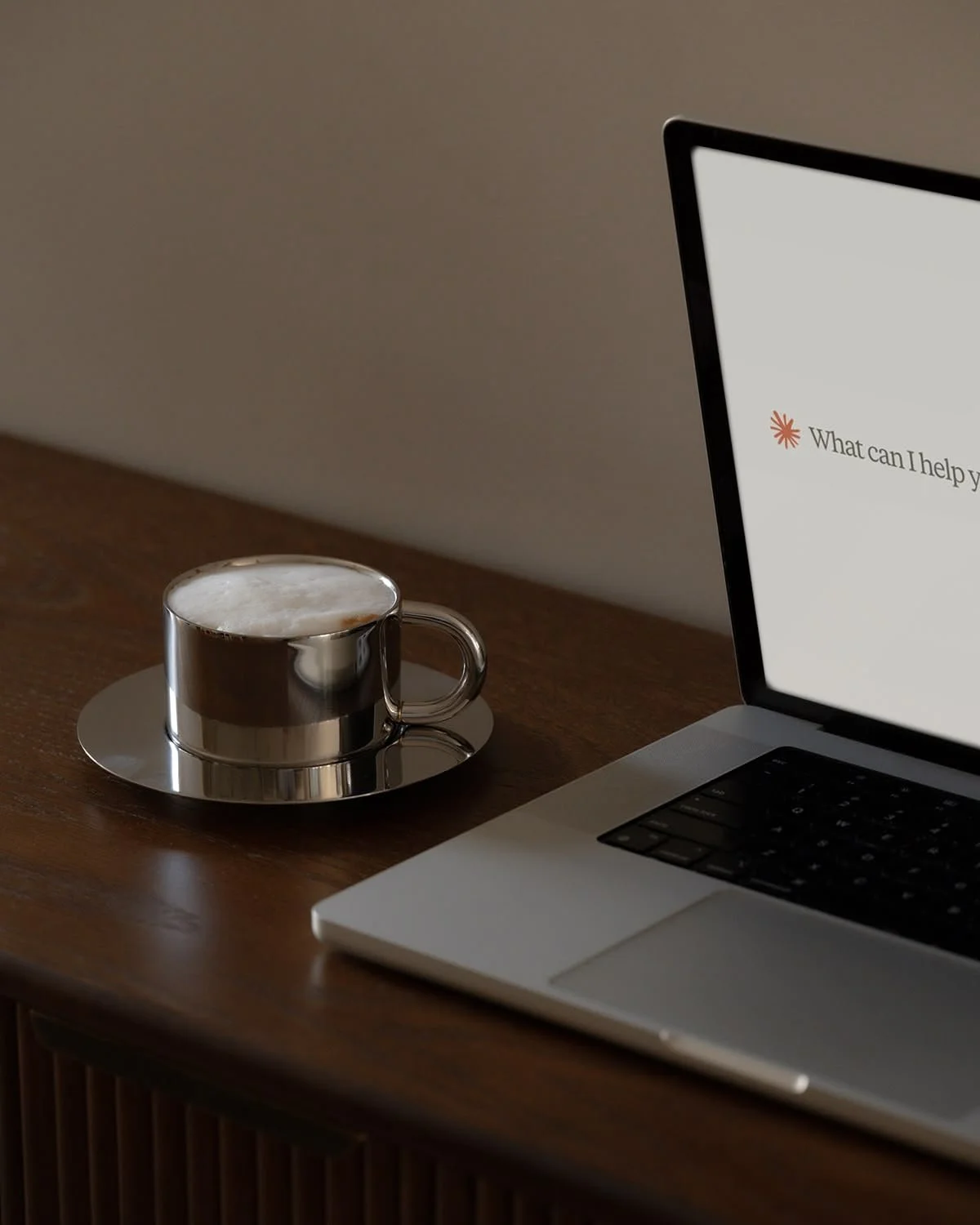
Has an interior design client come to you with AI “Inspiration” for a project yet?
You may find yourself explaining, “Well, this furniture doesn’t actually exist…that room would need a structural beam…and that layout wouldn’t allow space for HVAC.” In short, AI doesn’t give you a buildable plan for a room.
These answers feel instinctive because it’s your area of expertise. But with so much on your plate, you may be tempted to let AI handle some to-do list tasks for you, like updating your branding or website.
As an expert in that field, I’d like to sharpen your instincts on this matter before you take on that risk:
What AI is doing “under the hood”
Whether it’s a layout or a logo, when you type in a prompt and ask for an image, AI doesn’t just draw a picture. It generates a random grainy field—think television static noise—and moves the pixels around based on what it decides is most likely to come next.
What does that mean? It calculates what already exists in abundance, and spits out more of that. The safest, most literal version of whatever you typed in.
By definition, AI makes you look average. Even if you keep refining prompts, it continues to spit back the average of everything associated with the additional words you type in.
When you look at the resulting logo, it might feel good at first. It’s familiar, perhaps even reminding you of other brands you’ve seen. You may be excited for your work to be associated with those feelings.
Unfortunately, AI output also scrubs out the reason people hire you.
Your clients are aware that AI can generate room designs for them. They’ve probably even tried it already.
They hire you for your perspective.
Your creativity to see hidden solutions. Your ability to use old materials for new purposes. Your background in construction that grounds your design in the physical world. Your relationships with past clients that tell you what materials are most enjoyable to live with.
All of this, and more, makes up your brand story.
When you drop your information into AI, it erases what makes you different as it forms a calculated average of industry norms.
A useful test:
Swap out another designer’s name into your logo or website header. Do the font choices and colors still make sense?
If so, you don’t have a brand. In fact, you’d be advertising your own replaceability.
When you work with a graphic designer to tell your brand story, you’re highlighting what makes you exceptional.
When I work with clients, I take time to hear their entire story, and build visual signals into their brand that communicate wordlessly to clients. Like choosing an unbleached white to evoke a designer’s commitment to sustainability, or using subtle icons and emblems that represent meaningful parts of the brand owner’s life. The results are impossible to swap.
Just like you customize rooms to your clients lives, you can layer such personalization into your own brand. Done well, this becomes an unmistakable signal of your capacity to produce things that are one-of-a-kind.
(If people were excited by average, they probably aren’t your client to begin with.)
And just so you don’t have to find out the expensive way:
AI will not produce a buildable brand, either.
I know this sounds odd. You can put pixels anywhere you want, right?
Most AI simply spits out a .png file. This cannot be scaled up and down (from business card to poster size) without degrading in quality. For flawless results, you would need a vector file. Someone would need to retrace the entire thing by hand in Adobe.
There are a few AIs that will give you a vector file. But remember how AI starts with random noise and pushes it into patterns it sees as familiar? It’s not using actual fonts; it’s mimicking the shape of a familiar font. The letters won’t have straight lines, up close you will see bumps. Same issue with icons. So even your resizable vector file may not look ‘clean’ when sized up.
And there’s one factor AI still entirely neglects: the realities of business growth. The best part of my job is watching client brands grow beyond their wildest dreams. Your future contains press, networking, collaborations and opportunities you can’t even imagine - and I see the practical design needs people need over decades as they expand into these areas.
That’s why I never use lines so thin they wouldn’t show up on a letterpress business card. I pay close attention to how intricate my logomarks are (because you never know when one will need to be stamped into a wax seal). I know which fonts show up well on textured paper, and which look terrible. Everything I create shows up beautifully in the physical or digital world.
Not to mention…a brand is more than a logo. My clients receive a package of everything they need to represent themselves consistently: primary logo, secondary logo, alternate logos, icons, color palettes with a hierarchy, font collection, and more. When the door of a lifetime opens, you can stride right through looking your best.
AI will leave you scrambling to throw something together, simply because you didn’t know.
Final caution:
AI does not give you full protection for your hard work.
Currently, AI output cannot be copyrighted, because it is not considered creative work. AI output can possibly be trademarked, but there are many hurdles to demonstrating that you created something unlike anyone else (and plenty of interior designers do not trademark their logos or business names to begin with - they rely on copyright law for protection).
All this means that someone else could set up a lookalike to your AI brand, and you would have little to no recourse in stopping them. Your “brand” may fall in a legal gray area, or worse: the public domain, usable by anyone.
This is not the case with a 100% human-made custom brand, which is automatically protected by copyright, and much easier to trademark.
You could also accidentally infringe on someone else’s work. When you use AI, you also have no control over what was used to train it. The brand material it gives you could actually be a close approximation of an original brand that you don’t know exists.
If you make money using a brand that is close to someone else’s, they could come after you for infringement or force a re-brand.
Similarly, AI doesn’t use real fonts, it draws something that looks very close to one. But some fonts require licenses for commercial use. Many type foundries actively protect their intellectual property, and could come after you if you’re using a font that substantially looks like theirs without proper licensing. (This is something I guide all my clients through without worry.)
My purpose here isn’t to list all the problems with AI, or to scaremonger about possibilities.
I just want to underscore that while AI can technically create a logo, it cannot and will not give you a workable full brand that clears all the hurdles that will accompany an interior design brand over its lifetime.
And once you have a brand, it quickly multiplies out into everything you do. It gets progressively more expensive to hunt down and change every logo, email signature, website, welcome packet, business card, and envelope. As you probably know from your own work, the longer a problem goes unaddressed, the more expensive it becomes to fix.
You deserve a brand that represents what makes you stand out, grows with you, and comes with legal protection for your hard work.
Interested in a complimentary consult? Book one here.
